Gathering Inspiration at KBA Tabek, Talang Babungo
I cannot even remember the last time my fellow bloggers in Padang and I, the ones who belong to the Blogger Palanta community, were involved in an event together. Trying to recall it feels a bit like digging through old books in a library.
I was thrilled when one of the agencies reached out and invited me to take part in an event. And it felt like a coincidence, though I also choose to believe it as a coincidence — how do I even explain it. Just picture it: I had just fixed up my blog, tidied everything up, and then boom — there was an invitation to an event for bloggers.
But let us keep this intro short. So, around early August, Astra held an event as part of the lead-up to their big event, the Anugerah Pewarta dan Pewarta Foto for the year 2025.
In West Sumatra, they invited Photojournalists, Journalists and Bloggers to visit and see firsthand the KBA (Kampung Berseri Astra) in Jorong Tabek, Nagari Talang Babungo in Kabupaten Solok, which you could say is a village fostered by Astra through their CSR funds.
When I first got the initial information, I, having long stepped away from the world of journalism, honestly had no idea about this KBA Tabek, Talang Babungo, which it turns out has been around for a long time and is one of the tourist villages that gets visited often. So, this was my first time visiting.
From Padang, we would spend roughly 3-plus hours of travel by four-wheeled vehicle. Of course this long journey would not be boring, because along the way we would be treated to endless beautiful scenery.
I and my friends from Blogger Palanta in Padang set off, eight of us in all. There was me, Aul, Reza, Yonnie, Kak Nita, Eka, Puja and Ujib, then later joined by Bang Kiem, who set off from Bukittinggi on his own by motorbike. Because there were so few of us, we all rode together in one vehicle.
KBA Tabek, Talang Babungo and the Heroism of Climbing Out of the Dark
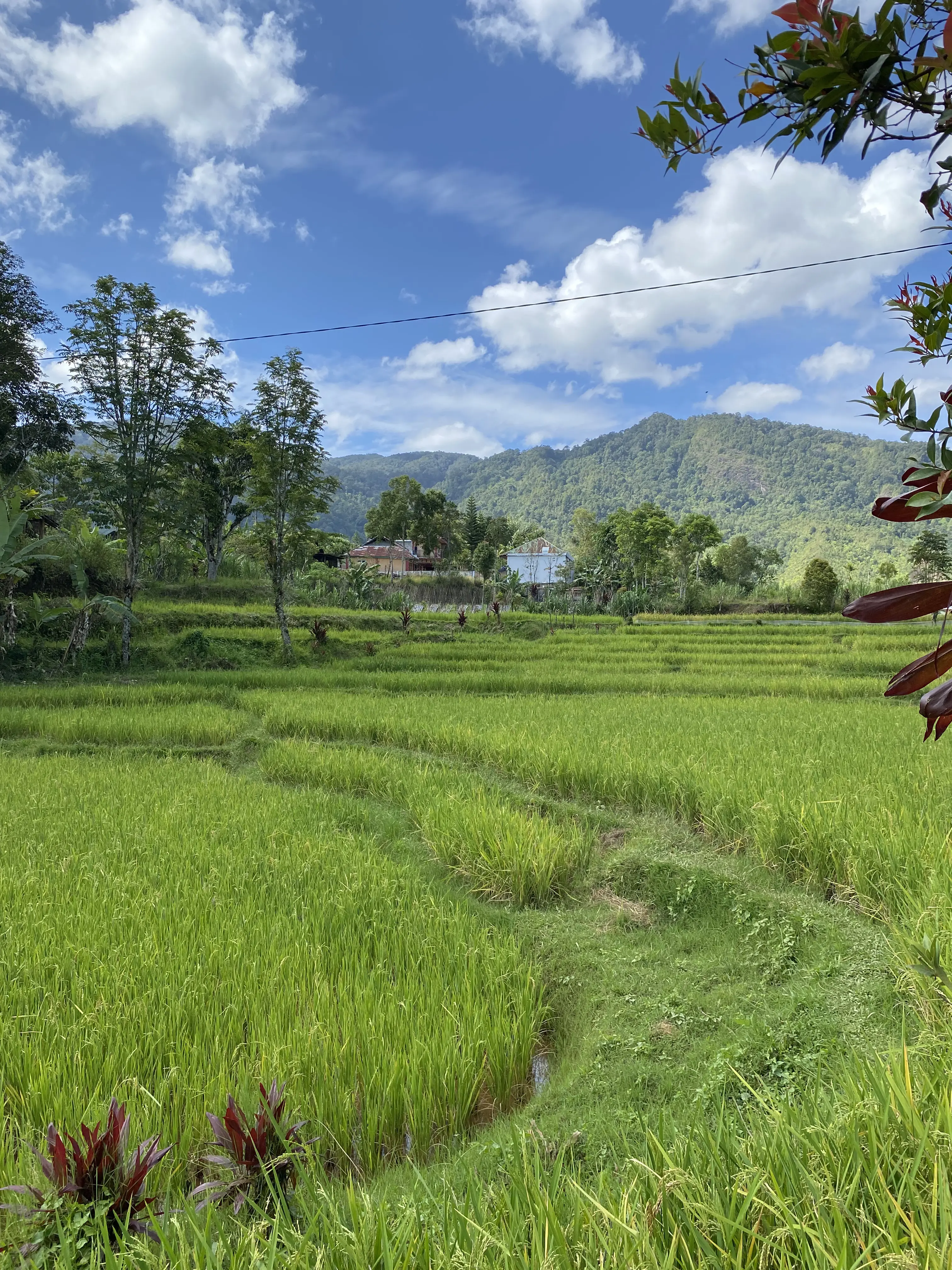
The first time we arrived, we were greeted with beautiful scenery, just like so many villages in West Sumatra. On one side it offered rice fields, and on the other, magnificent views of mountains and hills.
In my heart, the moment I first arrived, the question that then surfaced was "what makes this village special?"
To cut the story short, it turned out the villagers had prepared a special program for our whole group at a private Madrasah Ibtidaiyah (MIS), which served as the central venue for this event. It was complete, from dances all the way to the cuisine typical of Jorong Tabek.
Beyond the cuisine and the nature, even by the time the welcome ceremony was over, my earlier question still remained unanswered. Because when it comes to cuisine and the arts, many regions in West Sumatra have their own distinctive flair. But what was so special.
After the special welcome ceremony for our group, all the participants present, from Photojournalists to Journalists to Bloggers, entered a classroom that had been prepared. Before us were the Wali Jorong, Pak Kasri and a representative from Astra.
Pak Kasri, the Spark of Inspiration
After the Wali Jorong gave his remarks, I still had not found a satisfying answer to my earlier question. Until it was Pak Kasri's turn to speak.
Pak Kasri stood up holding the mic. His sturdy, tall and solid frame reflected a body that had been robust in his youth. His deep voice gave him an authority that no one else in the room possessed.
He began to tell his story, and this is where my ears perked up, because his story was so compelling. From Pak Kasri's account, it turned out that Jorong Tabek used to be one of the rather underdeveloped villages of its time.
From various angles, according to Pak Kasri's story, Jorong Tabek could even be called the poorest in Kabupaten Solok back then. There was not even a single university graduate in that village in those days.
Out of all the problems they faced, there were a few things the people of Jorong Tabek did, driven by Pak Kasri, that I actually found very fascinating.
Splitting the Jorong into a Zoning System
So, one of the ways to make it easier to break down and control the Jorong (village), was to divide Jorong Tabek into 11 Green Zones, each with a different focus of activity.
Each zone consisted of roughly 40 households, and was led by a single coordinator who reported directly to the Wali Jorong.
When I heard Pak Kasri's explanation, when I heard this idea, I thought to myself, "wow, that is pretty clever. It is like regional autonomy."
In terms of management, this is actually a simple yet brilliant idea. Because dividing the village into 11 zones with relatively smaller scopes makes control and problem-solving much faster.
On top of that, having a coordinator in each zone also allows the residents of a zone to take more responsibility and resolve smaller problems themselves.
Starting with Education

When we arrived, the spot where we got out of the car was right in front of a building built in the style of a stilt house with gonjong. Because if I were to call it a Rumah Gadang, it clearly is not the same thing. Even though it still uses gonjong and the structure of a Rumah Gadang.
After listening to Pak Kasri's explanation and story, only then did I find out that it was the Rumah Pintar. The first pillar that was built and reinforced in Jorong Tabek, and the foundation of Jorong Tabek's rise.
During the tour around Jorong Tabek, my friends and I had the chance to go up and into the Rumah Pintar. Many children were gathered there reading books. Some were alone, some were with their friends, and some were with university students doing their KKN (community service).
They filled every corner of the Rumah Pintar reading books. According to one of the residents, a woman (whose name I forget), this Rumah Pintar is the center of activity, the command post, the hub of Jorong Tabek. Everything is gathered, deliberated, and decided at the Rumah Pintar.
It is more than just a name; the Rumah Pintar also holds the charters, trophies, and achievement certificates of Jorong Tabek, as well as those of its children and youth.
According to Pak Kasri, building this Rumah Pintar was not easy, full of both physical and psychological challenges. On the physical side, the Rumah Pintar is supported by pillars made from Nira palm trunks, each pillar being extremely heavy.
I even tried to confirm this with several women and other residents, and the communal effort (gotong royong) to physically erect the Rumah Pintar was not carried out only by the men, but also by the women of Jorong Tabek.
With the Rumah Pintar and starting from education, Jorong Tabek has now reaped the rewards. These days, every household already has a university graduate or a student, and some have even earned scholarships to study abroad.
Excitement and Dissatisfaction
Honestly, the trip to Jorong Tabek was both exciting and, for me personally, unsatisfying. There are still so many fascinating stories I would love to dig into and tell.
We did not only go to the Rumah Pintar, but also went around to various important places in Jorong Tabek. Like watching the production of palm sugar crystals.
Trying out the human-powered sugarcane press, watching the women of Jorong Tabek pound emping, and tasting that emping firsthand, a traditional food that is now rarely found yet still exists in Jorong Tabek.
Honestly, I still want to hear so many more stories about Jorong Tabek, about Pak Kasri's struggle, about the inner turmoil of the people in their process of rising up.
And what is clear is, I hope this is not the only piece I write about KBA Tabek, Talang Babungo.